| Тренировка и правда убойная. Но со временем хочется разнообразия и поэтому ловите новую версию беспроигрышного сочетания бурпи и свингов от Марианны. Свинги, бурпи и пара упражнений с весом тела проверят вас на выносливость! Вес гири выбирайте средний – целью будет достаточно высокое количество повторений, но при этом до отказа доводить себя не следует. Тренировку также смело рекомендую всем, что хочет сжечь жир или весело и энергично закончить силовую тренировку. В тренировке 3 раунда по 6 упражнений. Общая длительность – 18 минут. Каждое упражнение выполняется 40 секунд, затем 20 секунд отдыха и переходите к следующему в круге. Для новичков можно использовать равное соотношение: 30/30. В оригинале отдыха между кругами не предусмотрено – но при необходимости – сделайте. В скобочках – цифры повторов Марианны в каждом круге, можете сравнить со своими. 1. Протяжка над головой + бурпи (9,8,8) 2. Свинг 2-мя руками (25,25,24) 3. Боковой подъём на опору (36,35,33) 4. Бурпи с отжиманием (14,12,11) 5. Свинг 2-мя руками (25,24,24) 6. Двойные прыжки (динамический присед+выпады прыжком) (10.5,9,8.5) Дополнения: • Если у вас нет платформы для подъёмов на опору – можно делать упражнения «звезда» (она же jumping jacks), «альпинист» или просто приседания без веса. • Меняйте бурпи исходя из своего уровня подготовки – можно убирать отжимания или прыжок или и то и другое. • Если есть опасения насчёт своих коленей, будьте внимательны на двойных прыжках, не торопитесь или вовсе замените на обычные выпады. Выпады в прыжке, особенно если торопиться – упражнение с повышенным риском для коленей. |
вторник, 10 ноября 2015 г.
БУРПИ + СВИНГИ: ВЕРСИЯ 2.0

"ПРОДВИНУТАЯ" ТРЕНИРОВКА С ГИРЯМИ
| И опять тренировка от моей «любимицы» Марианны Кейн (myomytv.com). Здесь потребуется довольно продвинутый уровень подготовки и набор из нескольких гирь. Если захотите выполнить занятие с одной гирей небольшого веса – тренировка из разряда продвинутых перейдёт в более лёгкую категорию. Тренировка состоит из 3-х частей и представляет собой микс из упражнений с весом своего тела, упражнений с гирями и упражнениями на мышцы кора. Каждая часть тренирует разные качества – от силы до выносливости. Мне нравится такой комплексный подход в рамках одной тренировки.  Часть 1: Сила При развитии силы сделайте особый упор на «качество» повторений, а не их количество. В этой части выполните 3 круга из 4 упражнений, затем следует «промежуточное» упражнение, которое выполняем между частями (только 1 сет) в качестве активного отдыха. 1. Становая тяга с 2-мя гирями: 8-12 повторений 2. Тяга-сумо с 2-мя гирями: 8-12 повторений 3. Становая тяга на 1 ноге (правая нога, левая рука): 8-12 повторений 4. Становая тяга на 1 ноге (левая нога, правая рука): 8-12 повторений В конце первой части: вращение вокруг головы (нимб) – 45 секунд в каждую сторону Часть 2: Силовая выносливость В этой части комбинируются гири и кардио-нагрузки, чтобы увеличить темп тренировки. Теперь отсчитывать будем не количество повторений, а интервалы работы и отдыха. Задача – работа на протяжении 45 секунд, затем 15 секунд отдыха и переход к следующему упражнению. Всего в этой части выполняется 2 круга по 4 упражнения. Вес гири выберите более лёгкий, чем в предыдущей части. 1. Выброс гири + выпад назад (правая сторон) 2. Выброс гири + выпад назад (левая сторона) 3. Тяги гири в упоре лёжа (тяга ренегада) 4. Свинг 2-мя руками В конце второй части: подъём таза на одной ноге (только удержание) – 45 секунд на каждую сторону Часть 3: Выносливость В этой части будут использоваться только упражнения с весом тела. 1. Бурпи (с отжиманием и прыжком) 2. Выпады с прыжком (правая сторона) 3. Выпады с прыжком (левая сторона) 4. Динамические приседания В конце третьей части: планка с поднятой рукой/ногой (с чередованием) – 60 секунд В этой части опять работаем интервалами: работа на протяжении 50 секунд, затем 10 секунд отдыха и переход к следующему упражнению. Всего в этой части выполняется 2 круга по 4 упражнения |
воскресенье, 8 ноября 2015 г.
Kettlebell Flips

Kettlebell flips are great to develop explosive strength and grip strength. Russian Judokas and Sambo practitioners utilized this method for many years. You will need explosive hips to get the kettlebell enough air time to make the flip. When the kettlebell is coming down it will have a higher momentum in relative to a swing, assuming you are using the same weight kettlebell for both exercises, and you will have to grip and contract your muscles fast and strong enough to make sure the kettlebell does not hit the ground. This exercise will improve your hand and eye coordination as well.
Please note that this is a very elite exercise and should not be practiced until exercises such as kettlebell swings, snatches, cleans are perfected. Another thing to keep in mind is to use a very light weight in the beginning. Since the kettlebell will be coming down fast with momentum, even the light kettlebells can feel quite heavy. The weight should slowly be increased with time. If the weight is increased too fast, you can easily injure yourself. If the progression is not done correctly, this exercise is perfect way to injure your shoulder or elbow so please use with caution.
Check out of Martin Rooney and Jim Miller Rocking rockin out with kettlebell flips.
пятница, 30 октября 2015 г.
Anatomy of the Kettlebell Swing
The swing is the foundational movement of kettlebell training. It teaches movement patterns, breathing protocols, energy management and key principles that carry over to other exercises and countless athletic activities.
The benefits of the swing are equally diverse. It’s a fully body exercise that synergistically couples strength training with aerobic/anaerobic conditioning and develops a “smart” nervous system. The swing and its variations can be used to burn fat, improve power, boost endurance, enhance mobility and develop a host of other attributes on the athletic continuum. Moreover it’s becoming increasingly popular in the therapeutic community as a way to counter injury due it’s focus on strengthening the posterior chain.
The focus of this article will be on movement mechanics and proper breathing in the swing. In future articles, we will cover additional variations, training programs and more.
To start, we want to discuss hip and knee mechanics in the swing. There are two primary variations:
*Squat swing – like the name implies, as the kettlebell is swung between the legs, the lifter squats down via flexion in the hip, knee and ankle joint. Spine is neutral and head is neutral. From there, the bell swings up and the same joints go into extension. This is a leg dominant vs. momentum based movement, allows for faster pacing and is ideal for heavier weights, interval work etc. based on how quickly it jacks the heart rate.
*Pendulum spring - as the kettlebell drops, the weight of the bell is first absorbed via a shallow knee bend, the hips then transition the energy backward in a horizontal plane, knees move toward locking/close to locking and the movement is reversed back into extension. As with the squat swing, the spine is neutral, the head is neutral with the primary difference being that it is a momentum based vs. leg dominant movement. So, it’s more congruent with longer sets (example – 10 min k-bell sport competition sets) due to it being less “work”, more efficient via lowering the heart rate etc.
So, both have benefits depending on the weight of the bell, goal for the training session and anatomy of the athlete.
In regard to breathing, there are two general variations:
*Paradoxical breathing – as the kettlebell drops in the backswing, the athlete’s inhales, then as the k-bell finishes the upswing, the athlete exhales. In other words, inhale on compression, exhale on extension. This breathing variant creates thoracic pressure which protects the spine. Thus, a good match for heavier weights and de-conditioned lifters who struggle with core stability.
*Anatomical breathing – this is the reverse of paradoxical breathing. Instead of inhaling on compression and exhaling on extension, you exhale on the backswing (compression) and inhale on the upswing (extension). To make conceptualizing the rhythm easier, only think of the exhale points since if you blow out with enough force to create a casual puffing of the cheeks, the inhale will take care of itself/happen organically.
For 1 cycle anatomical breathing, the exhale is at the back of the backswing. For 2 cycle anatomical breathing, the first exhale is at the back of the back swing and the second exhale as the arm leaves the body before finishing the upswing. This type of breathing is ideal for maximizing oxygen and lowering heart rate.
In addition to hip/knee mechanics and breathing, I also want to talk about the importance of “connection” and “deflection”.
*Deflection – at the top of the swing, the lifters wants to extend the pelvis so the upper body “deflects” back. This compensates/keep the body balanced for the load in the front. In addition, as the kettlebell starts to drop into the backswing, the athletes want to maintain this deflection until the tricep/elbow makes contact with the torso. Once that happens, the lifter can then transition into the squat or pendulum spring mechanic. This timing counters trauma to the back and keeps the body unified during the movement.
*Connection – as the bell swings between the legs, we want to focus on keeping the arm connected to the hips/inner thigh and maintain that on the upswing for as long as possible to ensure power transfer from the primary movers (legs, hips, back) to the secondary movers (arm). As with deflection, we want the body to stay unified via working together as one unit vs. separate individualistic parts.
Last, in reference to what the free arm is doing, we want it relaxed and mimicking the path of the k-bell.
I hope this helps with your training! As mentioned, in future articles, we will dive into additional technical details, corrective drills, advanced variations, example workouts and more!
 | Ken Blackburn is the International Team Leader and Head Master Trainer for the IKFF (International Kettlebell & Fitness Federation) and is widely considered amongst the top kettlebell sport coaches in North America. For information on his online training, IKFF certifications and/or seminars, you can contact him at kenblackburn@ikff.net |
Basic Yet Effective Kettlebell Swing Workouts for Martial Arts and MMA
In the last article, we discussed the general mechanics and breathing involved in the kettlebell swing. Now, we will look at example workouts that target “work capacity” – the ability to be strong , explosive yet fluid over longer durations (1 to 5 min). Although the focus is on the swing for Mixed Martial Arts, the following protocols are applicable to anyone who wants to improve their strength, cardio and overall athleticism. In other words, you don’t have to be a fighter to train like one.
The swing is an ideal movement for any combat athlete due to the quick transition from a compressed posture (squat) to full body/hip extension. This mimics “from the ground up” power generation used in striking and specific movement mechanics involved in numerous submissions (example – armbars). In addition, it’s also congruent with the heart rate demands of an athlete competing at anaerobic threshold (80% to 90% of max hear rate) for an extended amount of time.
As you will see below, it’s not just weights, reps and sets. We also focus on what we call “training for time”. For the below, we use the example of an MMA fighter whose rounds are 5 minutes in length. Of course, the time can be changed/adjusted depending on the activity (Boxers competing for 3 min rounds)
To start, we will utilize a basic hand to hand swing (switch hands at the top of every repetition) to illustrate this concept. Below is an example progression to 5 min.
Hand to Hand Swings:
Week 1: 1 min set x 1 min rest x 5 sets
Week 2: 1:40 min set x 1 min rest x 3 sets
Week 3: 2:30 min set x 1 min rest x 2 sets
Week 4: 5 min set x 1 set
To build hip drive, explosiveness and overall power, we can use a double swing (done with two k-bells). Due to the heavy loading, these drills are best configured as “sprints”. Below is an example progression.
Double Swings:
Week 1: 10s on x 10s off x 10 sets
Week 2: 15s on x 15s off x 10 sets
Week 3: 30s on x 30s off x 10 sets
Week 4: 1 min on x 1 min off x 5 sets
Week 5: 1 min on x 30s off x 5 sets
To build coordination, footwork and the ability to respond to external stimuli, the two handed walking swing is excellent ! The athlete will hold the k-bell with two hands, a coach/training partner will give a command on the backswing to “walk forward”, “walk back”, “step to the right, “step at a 45 degree angle” etc and they respond accordingly. If they struggle with the response/reflex element, a pre-arranged “k-bell kata” can be constructed instead of the coach calling out commands. Example - three steps each direction plus three 45’s for the designated time. Below is an example progression:
Two Handed Walking Swings
Week 1: 1 min on x 1 min off x 5 sets
Week 2: 1:40 min on x 1 min off x 3 sets
Week 3: 2:30 min on x 1 min off x 2 sets
Week 4:5 min x 1 set
Key Points:
The above is a general/linear template. Depending on the athlete, variables such as the weight of the k-bell, work time and recovery time can be modified. As an example, if an athlete is attempting to transition to a higher weight and is struggling, the sets can be alternated between that weight and a lighter weight.
Pacing inside a set should be tracked as well. So, overall, the athlete is monitoring/measuring variables such as the length of the set, rest time, weight of the k-bell and reps per min to assess progress. Done this way, it removes the ambiguity surrounding whether performance is improving or not.
Heart rate is another excellent variable to track. So, if the same workout is done in month 1 and month 2 and all other variables are the same (weight, set length etc), a lower heart rate in month 2 is indicative of a conditioning improvement. Conversely, if the heart rate is significantly higher, it can be valuable in terms of identifying a problem with recovery, over-training etc.
Milestones to shoot for – Regardless of activity, it’s important to have goals. As an example, for the hand to hand swing drill, a 165lb athlete I trained was aiming for a 5 min set with a 40kg k-bell (88lbs). After first completing with a 20kg, 24kg and 32kg bell, he eventually progressed to completing with the 40kg bell at a pace of 30 reps per min (13,200lbs of work). This type of conditioning has tremendous carry over to a combat situation. Moreover, due to the nature of this training, it tends to build strength and endurance but not bulk (important to those fighters not wanting to bump up a weight class)
As mentioned in the previous article, everything starts with good technique and breathing. This ensures optimal performance and most importantly, avoiding injury and staying safe.
Of course, there are infinite variations with these drills. They can be combined with bodyweight movements, running, skipping rope, hitting focus mitts etc. Example – hit the mitts for 1min and alternate with 1 min of hand to hand swings with the eventual goal being a continuous 5 min set. Be creative and have fun!
In a future article, we will talk about combining the kettlebell with the Bulgarian Bag! The later being a phenomenal tool for developing rotational power and conditioning!
 | Ken Blackburn is the International Team Leader and Head Master Trainer for the IKFF (International Kettlebell & Fitness Federation) and has been an active martial artist for over 30 years. He currently coaches several fighters on their strength & conditioing including UFC Fighter Joby Sanchez. For information on his online training, IKFF certifications and/or seminars, you can contact him at kenblackburn@ikff.net |
четверг, 29 октября 2015 г.
Side-Step Kettlebell Swing
This is an intermediate-to-advanced level move that offers many similar benefits to the standard swing – it develops power and explosiveness, will help you burn fat and take your conditioning to the next level, and much more … BUT it also adds in a little extra “twist” that makes it a fun variation to add to your KB workouts.
Here’s how to do it:
1 – Begin with the basic two-handed swing
2 – When the kettlebell is on its way down, put your right foot out and step to the right
3 – When the kettlebell is up, bring your left foot over to meet your right foot, so your feet are together
4 – Continue taking steps to the right as space allows, then change direction and side-step to the left for the same number of repetitions
And here’s what the exercise looks like:
Try that one during your kettlebell workout today, and let me know how it goes!
- Forest Vance
Level 2 Certified Russian Kettlebell Instructor
вторник, 27 октября 2015 г.
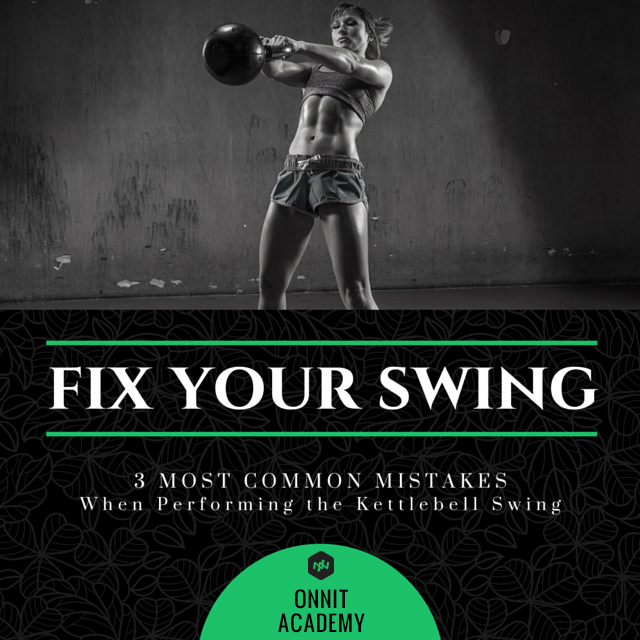
3 Most Common Mistakes When Performing the Kettlebell Swing Exercise

‘Neutral Spine’ is spoken more than any other phrase when I’m training someone how to properly use a kettlebell. I preach the importance of a neutral spine with a vast majority of not just kettlebell exercises, but all movements. So why are so definitive on this concept and why do we believe it is so important?
Firstly, we need to define what a neutral spine is as we often have people confused with what actually constitutes a neutral spine. The greatest misnomer is that it is a flat spine. This, of course, is not true. The spine has ‘natural’ curves that need to be maintained under load.
Performing the Kettlebell Swing with a Neutral Spine (Eyes on the Kettlebell)
Defining a neutral spine even further is problematic as the angles can differ between people (for example women have more of an anterior pelvic tilt than men). However, the optimal spine curvatures are between 30-35 degrees for the lumbar lordosis and the same for the thoracic kyphosis and cervical lordosis (Chek 2001).
A neutral spine can also be characterized by the position where there is the least possible stress to the surrounding passive subsystem of the joints.
When we compromise these curvatures and place more stress on the surrounding subsystem of joints, then we increase the likelihood of an injury occurring. 60-80% of the population suffers back pain or injury at some point. In the majority of cases, this could have been avoided with proper spinal positioning both when exercising with a kettlebell and when performing everyday activities.
I often hear the lay person say that “Kettlebells are bad for the back”. It’s true…. Kettlebell exercises are bad for the back when they are performed without a neutral spine. While maintaining a neutral spine the opposite is true – kettlebell swings are one of the best exercises for developing strength in the lower back and posterior chain.
One of the areas that is most contentious is the neck position in movements such as the swing, clean and snatch. The neck is part of the spine yet people love to look upwards throughout the motion. Overemphasized lordosis in the neck will trickle down to the thoracic and lumbar spine (Weingroff).
You see, the hyperextended curve in the neck will need to find compensation further down the spine and therefore, further lordosis of the lumbar spine will occur. This means we increase the potential for stress in the spine and can increase the shearing forces in the discs.
Most Common Mistake #1. The Kettlebell Swing with the Neck Hyperextended
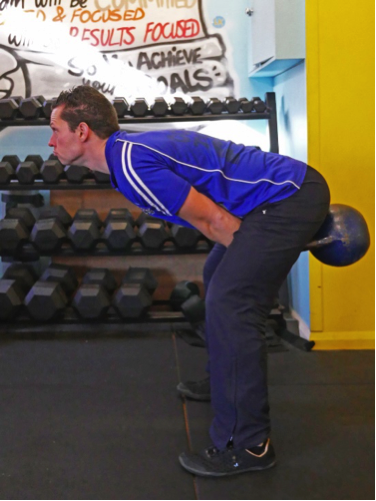
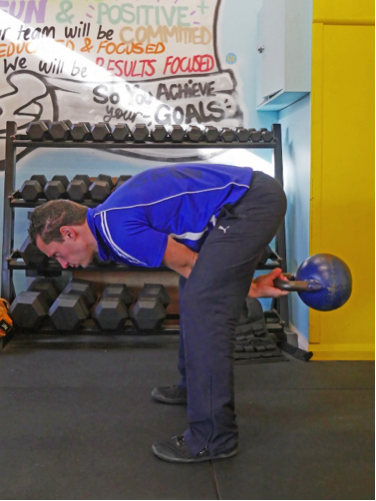
You may be completing kettlebell swings with excessive lumbar flexion and not feel it in your back as you do so. However, you are most definitely doing long term damage and there will be significant ramifications in the future. Repeated flexion of the spine leads to shortened tissues on one side of the joint and lengthened tissues on the other.
The shortened tissues become compressed and dehydrated and this leads to a decrease in contractile strength. On the other side, the lengthened tissues will lose their tensile strength. This decreased strength can culminate to a greater vulnerability to injury from decreasing loads (McGill, 2002).
It is quite common to see people suffer a back injury after doing something innocuous such as sneeze, lift a light load or pick up their child. It is the years of excessive flexion and loss of neutral spine that led to this point and created this vulnerability.
Most Common Mistake #2. The Kettlebell Swing with Excessive Lumbar Flexion
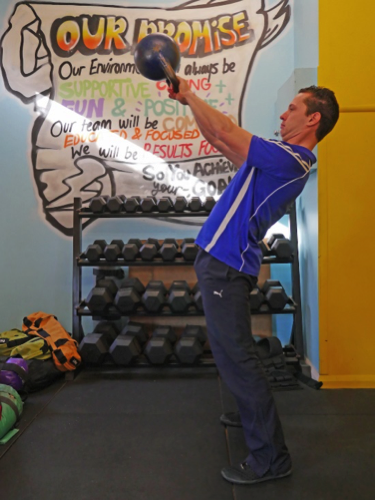
Excessive lumbar hyperextension at the top of the kettlebell swing or deadlifts is also quite common and happens unknowingly in many cases. This has the potential to damage the facet joints and impact the nerves. It should be avoided at all costs.
Most Common Mistake #3. Hyperextension in the Kettlebell Swing
Quite often you may be completing movements without a neutral spine and may be totally unaware. Many people find it difficult to coordinate a hip hinge movement whilst maintaining a neutral spine.
They lack lumbopelvic rhythm and there is excessive flexion or extension somewhere in the spine as a compensation. Creating an awareness of moving with a neutral spine is a necessity and there are a few techniques that can reinforce this.
The first is completing the hip hinge with a dowel held along the spine. The key is to maintain the 3 points of contact (head, in between the shoulder blades and the sacrum) on the dowel.
The Dowel Technique
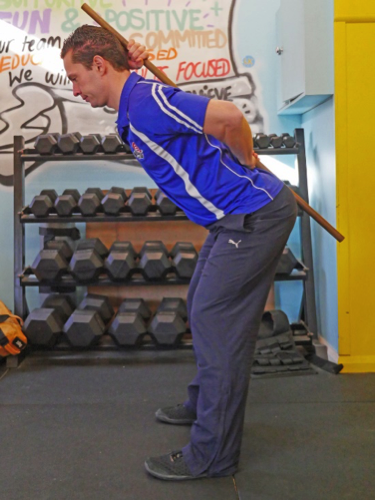
Once you are proficient with the movement and maintaining contact, then you can add an external load and remove the dowel. Getting a video of your movements via the application ‘Coach’s Eye’ is a great way of monitoring the technique and ensuring the neutral spine is maintained.
The ability of the spine to handle compressive forces is also vastly diminished when it is not in a neutral position. In addition, performing exercises – all exercises, not just kettlebell exercises – with a neutral spine also optimizes the length-tension relationships that allow a greater capacity to generate force. Transversus abdominus activation is also optimized.
Maintaining a neutral spine leads to less injuries, unnecessary compensations, energy conservation, better core activation and an increased capacity to handle compressive forces as well as improved scapular mechanics.
I hope you can now see why we so passionately preach the importance of a neutral spine within our courses and are convinced it is imperative when doing a kettlebell workout, but with other forms of functional training as well.
The Kettlebell Swing: Correct Vs. Incorrect Form
References
Chek, P. (2001). Movement that Matters
McGill, S. (2002). Low Back Disorders: Evidence Based Prevention and Rehabilitation.
Weingroff, C. (2010). Packing the Neck. http://charlieweingroff.com/2010/11/packing-in-the-neck/
McGill, S. (2002). Low Back Disorders: Evidence Based Prevention and Rehabilitation.
Weingroff, C. (2010). Packing the Neck. http://charlieweingroff.com/2010/11/packing-in-the-neck/
Подписаться на:
Сообщения (Atom)