суббота, 28 января 2017 г.

Kettlebell Swing


To learn the fine details of the Kettlebell Swing, don’t forget to check out the Hip Hinge which is the foundation of the Kettlebell Swing. To learn the Kettlebell Swing online with a Caveman Kettlebell Trainer go to KBTE and buy a course.

THE KETTLEBELL SWING

the most important kb exercise you need to know
– presented by Taco Fleur
The Kettlebell Swing is the foundation for many other Kettlebell exercises and therefore it is important you become proficient in this exercise and understand each fine little detail of the exercise.
If you’re in a rush and want to get cracking with the Kettlebell swing right away and don’t have time for all the finer little details then this video is not for you, just Youtube a 30s video and you’ll be fine… NOT (sarcastic)
The Kettlebell swing is a full body exercise and really helps to strengthen the posterior chain muscles.
The posterior chain muscles are comprised of various muscles but some of the main muscles are biceps femoris, gluteus maximus, erector spinae muscle group, trapezius, posterior deltoids, and so on.
The Kettlebell Swing is very similar to the Deadlift, the main difference is that the weight swings and the movement is explosive, the hinge movement of the hips is the same.
When the Kettlebell Swing is referred to it is in most cases the Russian Swing that is referred to, the other popular but different swing is the American Swing.

LETS BEGIN

Stand in spine-neutral position with feet slightly wider than shoulder-width apart with the Kettlebell in-front of you.
Maintain a neutral spine at all times during the swing, with the only exception being during the backwards phase of the swing when the head is slightly tilted up.
Keep the feet flat on the ground at all times to be able to push into the ground and activate the right muscles to propel the bell forward.
Keep the elbows locked out at all times. (Alternative) Keep the arms straight at all times.
Leave the arms relaxed and only use them as a pendulum so the Kettlebell can swing freely.
Hold the Kettlebell by the handle with both hands and a loose grip.
Pull the Kettlebell off the ground and between the legs.
Snap the hips forward and bring the upper-body upright to propel the Kettlebell forward.
Do not involve your shoulders to lift the Kettlebell upwards, let the force from the snapping of the hips and the coming upright of the upper-body propel the Kettlebell.
Do not hyper extend the back when snapping the hips forward, in other words do not push your hips past your ankles and shoulders.
Make sure to squeeze the Glutes when snapping the hips.
The top of the swing is when the Kettlebell is motionless in the air for a split second.
The Kettlebell usually reaches about chest height but keep in mind that the Kettlebell only needs to swing as high as the force generated by your hips will move it.
At the top of the swing remember:
  • chest out and shoulders back
  • engage the core
  • squeeze the glutes
  • legs are straight but knees are not locked out
When the Kettlebell starts to fall down, its time to break at the hips.
The Kettlebell should come through the legs approximately around the knees, you should be able to put another Kettlebell between your legs and not hit it.
Elbows/forearms should be making contact around the waist line, and part of the wrists around the upper thighs.
Exhale through the mouth.
Inhale through the nose.
Break at the hips and push them backwards (AKA Hip Hinge), try and keep the knees above the ankles as much as possible. This is also known as the Hip Hinge.
You should feel tension on the hamstrings when pushing the hips back, and remember that this is not a squat.
Adjust repetitions and weight based on your goals and program. Visit http://kettlebells.co for Kettlebell complexes involving the Kettlebell Swing.
Pick a weight too light and you don’t get the resistance you need to activate the right muscles, pick a weight too heavy and your form will go out the door.
As a general rule and keeping in mind everyone is different. I would only use a 6kg Kettlebell for a child, and start women on 8kg at least, even when starting out.
If form goes out the door even with 8kg, then I would reset rather than go to 6kg and go through the exercise again making sure the client understands what muscles to activate etc.
I start men out at least at 10kg or 12kg. Make sure to assess your clients’ swing from side and front-on.

BAD FORM

No hip drive – will fatigue quickly in shoulders and lower back
Coming too low – lower back will start hurting
Hyper extending the back – prone to more serious injury
Happy feet – not able to activate the right muscles
Our exercises are explained into the fine little details, based on our experience over the years, however, not every human-being is build or functions the same, therefore keep in mind that certain moves might not work the same for your body, always use common sense and adjust the exercise to your body.
As long as the exercise is performed safely, any slight adjustments should be fine, if unsure, visit our forum on http://kettlebells.community and ask your question under “The Kettlebell Swing”.
Visit and sign up at http://kettlebells.community to get access to Trainer Cues and Tips and Drills to perfect the Kettlebell Swing, things like Squat Jumps to make the client feel the explosiveness required when snapping the hips.
http://kettlebells.community is THE world-wide website for Kettlebell enthusiasts, and most videos and articles are posted there before anywhere else. It’s a great place to ask any questions and share your knowledge in the forums as well.
Want to see a video on Kettlebell Swing variations? As soon as this video hits 1,000 likes I’ll bring out a video on Kettlebell Swing variations. So help yourself out and share plus like this video, you’re also showing us that you appreciate the time I invest in this.

The Goblet Squat or rather Goblet Grip


“No, that’s not a goblet squat, that’s not a goblet squat and that’s also not a goblet squat nor grip!” Almost everything where people hold a kettlebell in-front of them with any type of grip is now called a goblet squat these days. The meaning of goblet has completely eloped from the naming!
Goblet
Let us have a look at what a Goblet is. A goblet —also known as chalice— is a drinking glass with a foot and a stem generally used during religious ceremonies. The ancient Roman goblet was a drinking vessel consisting of a bowl fixed atop a stand, and was in common use at banquets. Note that the size of the bowl was big, thus two hands were required to drink from it, holding it by the stand was not an option. With that image in mind, replace the Goblet with a kettlebell where the bell is the bowl, and the handle plus horns are the stand.
Goblet squat grip
If you watch movies with knights, queens and kings in it you’ll pretty much always see them hold the goblet with two hands around the big bowl when drinking from it.
The generic name for these kettlebell squats are front squats, since the kettlebells are pretty much always positioned at the front of the body. The other options are back, overhead, hang and dead. If we want to get more specific then we start looking at the grip of the kettlebell and include that in the exercise name, some examples for the front squat;
  • racked
    • single arm
    • double arm
  • goblet grip
  • reverse goblet grip
  • crush grip
  • horn grip
  • horn grip upside down
  • open hand horn grip
  • interlocking grip
  • open palm grip
    • single arm
    • double arm
  • noob grip
    • single arm
    • double arm
A cool one for the back squat is the kettlebell fireman’s grip. Haven’t heard about that one yet? Stay up to date with our facebook as I’ll soon release a video with squats performed utilising all the above grips.
Open palm kettlebell grip
Is there a difference between goblet and crush grip? Yes, with the crush grip the objective is to hold the bell in such a way you need to crush it to keep grip on it, with the goblet it rests more in the palms of the hands.
Do these grips make a difference on the muscles engaged? Yes they do. If you want to know more, then download the Cavemantraining kettlebell grip document for free and buy our book on the kettlebell press which goes into details on some of this.

Does it matter what you call you it in the end? Well, yes it does if you put things out for the public to see, it causes confusion. Is it a biggie? Yes, no, maybe, who cares! Personally, I like to get specific and name appropriately where possible. Am I still going to be your friend if you come up with different names or name incorrectly. Of course I will.

воскресенье, 15 января 2017 г.

Getting Fit From Scratch: It's Time to Pick Up the Kettlebells

понедельник, 2 января 2017 г.

TWO CUES TO CLEAN UP YOUR TURKISH GET-UP


SHARE THIS:   
Hope everyone’s New Years was fantastic and safe. Lisa and I celebrated our last Holiday as non-parents by being lame and going to bed at 9 PM New Year’s Eve. We figured we’d start a new hash-tag to highlight the fact: #sleepingwhilewecan.
2017 is here and with my first post of the year I wanted to discuss two common mistakes I see people make with their Turkish Get-Up.

Lisa has been on vacation from work since before Christmas and I’ve taken advantage of tagging along in the mornings to train with her at her commercial gym. I don’t make it into commercial gyms all too often, but when I do you can bet two things will happen:
  1. I have to do everything I can to not want to gauge out my corneas.1
  2. I always pick up some good ideas for blog fodder.
During the past week I’ve noticed a lot of people performing Turkish get-ups, which is awesome. I think it’s rad to see more and more people venturing out of their comfort zones. Unfortunately, I’ve also noticed a few common themes with regards to questionable technique while observing the same people. Mistakes that are very subtle in nature, but can make a profound difference when it comes to reduced injury risk when corrected.

1) Rolled Shoulder vs. Packed Shoulder

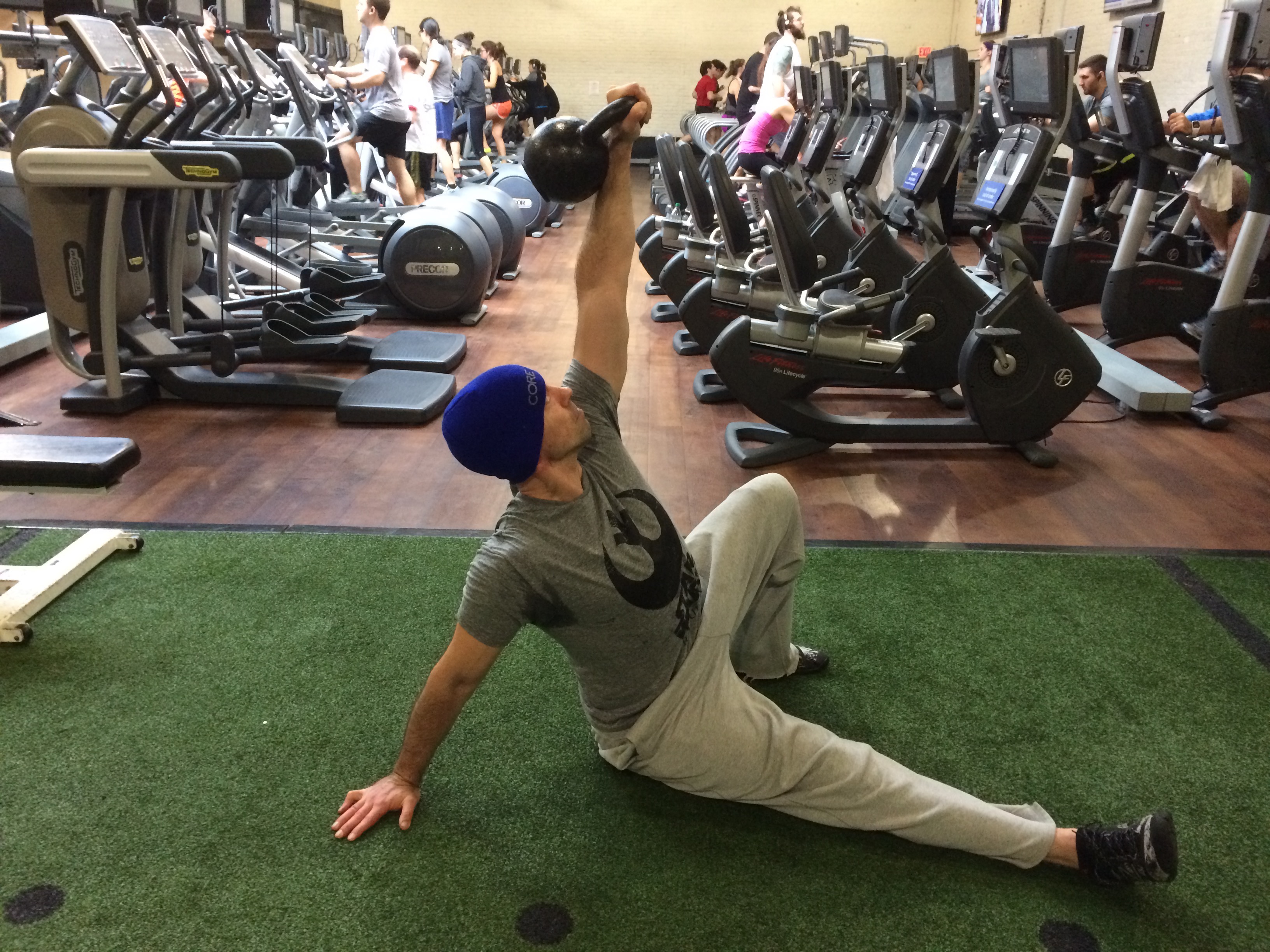
This is the one snafu I see the most often. When someone transitions from the forearm to the “T” position (to the hand) they’ll allow the shoulder supporting their weight to roll forward. Kinda like this:
rolled-shoulder
Ouch.
With bodyweight or a lighter KB it won’t be that big of a deal. However, it’s a bad habit to fall into (even with light loads) and is going to place a lot of strain on the anterior shoulder, most notably the bicep tendon.
The better approach is to ensure a “packed” shoulder. Like this:
packed-shoulder
Bonus points for the sick Star Wars t-shirt. Demerit points for pitting out. My bad.
The simplest verbal cue I’ll use in this case is to tell the person to “place you shoulder blade in your back pocket” or maybe to say something to effect of “cork screw your hand into the ground.”
Both work equally well and place the shoulder in a far superior (and stable) position to transition forward.

2) Not Getting Under the Bell

Another common mistake I see often is people not getting underneath the bell when transitioning from the tripod/3-point stance to half-kneeling.
Most will perform more of “teapot” motion cranking through their lumbar spine (<– props to Artemis Scantalides for the teapot analogy) rather than hinging INTO their hips to get underneath the bell.
Here’s a quick 1:15 minute video explaining what I mean:


Learning to use the hips is crucial here and helps with getting a feel for what it means to “control” the bell. Not surprisingly some people struggle with this. Here’s simple way to groove things and get those hips nice a juicy:

Give the above suggestions a try and let me know if they make a difference. If not, I guess I’ll GFM…;o)